
A suppression of sound
The Silent Voices of the Forest
In the quiet corners of the world, where rivers carve their paths and trees stretch toward the sky, animals live lives shaped by instinct, rhythm, and balance. For centuries, their existence has been a steady song, unbroken by human interference. Yet in recent times, that song has faltered. The animals, though voiceless in our language, carry a weight of sorrow that echoes through their movements, their silences, and their eyes. What if we tried to hear them for a change? We should strive to amplify their voices. It starts with one small whisper. This is my whisper. Yours takes life when you read this and pass it on.

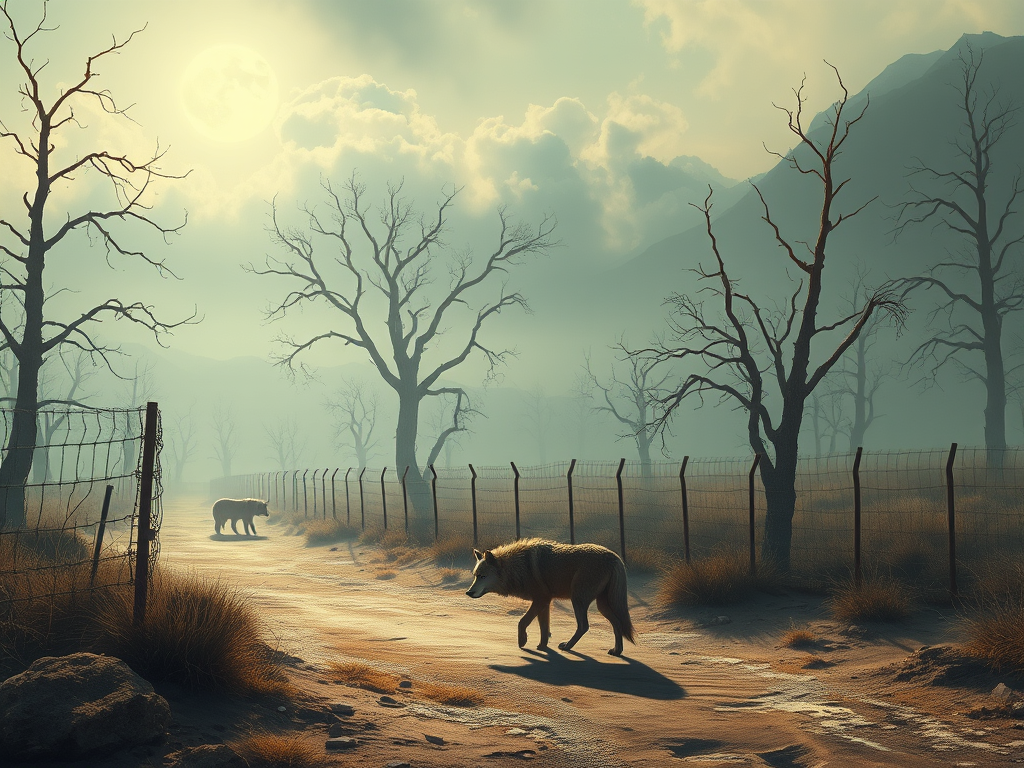
The wolf, once roaming vast territories with its pack, now paces the narrow confines of a reserve. He does not understand why the horizon has shrunk, why the scent of prey has faded, why the calls of his kin are distant echoes. His depression is not born of weakness but of loss—the loss of freedom, of choice, of the wild expanse that defined his being. He did not agree to this change. It was thrust upon him, without recourse, without explanation.

The elephant, matriarch of memory, feels the ache of displacement. Her migration routes, etched into her mind by generations, are blocked by fences and roads. She leads her herd to the edge of a highway, confused by the roar of machines that never yield. She remembers the watering hole that once lay beyond, now drained and paved. Her depression is heavy, carried in the slow sway of her body, in the quiet rumble of her voice. She did not choose this interruption. It was imposed, and she bears it silently.

The songbird, once herald of dawn, now sings against the hum of engines and the glare of artificial light. Her nest is shaken by construction, her trees felled for progress. She flutters from branch to branch, searching for a home that no longer exists. Her song grows thin, uncertain, tinged with despair. She depends on handouts from us more and more to eat. She did not ask for her skies to be filled with smoke, her mornings drowned in noise. Yet she must endure, wings beating against a world that has changed without her consent.

Even the loyal dog, companion to humankind, feels the sting of depression when his life is altered without explanation. He waits by the door for an owner who no longer returns, his tail drooping, his eyes clouded with confusion. He cannot understand abandonment, nor the shifting of human priorities. His depression is quiet but profound, a testament to bonds broken without warning.
conclusions
These animals, diverse in form and spirit, share a common truth: their lives are changed without their say so, and they have no recourse. They cannot petition, cannot protest, cannot demand justice. Their depression is a silent protest, a muted cry that reverberates through the natural world.

And yet, in their sorrow lies a lesson for us. To recognize that freedom, choice, and respect are not human luxuries alone—they are threads woven into the fabric of all life. When we alter the lives of animals without care, we unravel those threads, leaving behind not only broken ecosystems but broken spirits. Mine included. Yours too?
The forest, the savanna, the sky, and the home—they are filled with silent voices. Voices that remind us that depression is not only a human condition, but a universal response to loss, to change without consent, to the stripping away of dignity.
If we listen closely, perhaps we will hear them. And perhaps, in hearing, we will learn to honor their lives with the respect they deserve.
Can you hear it?
it is over now
Comments
One response to “The voices not heard”
[…] The voices not heard […]