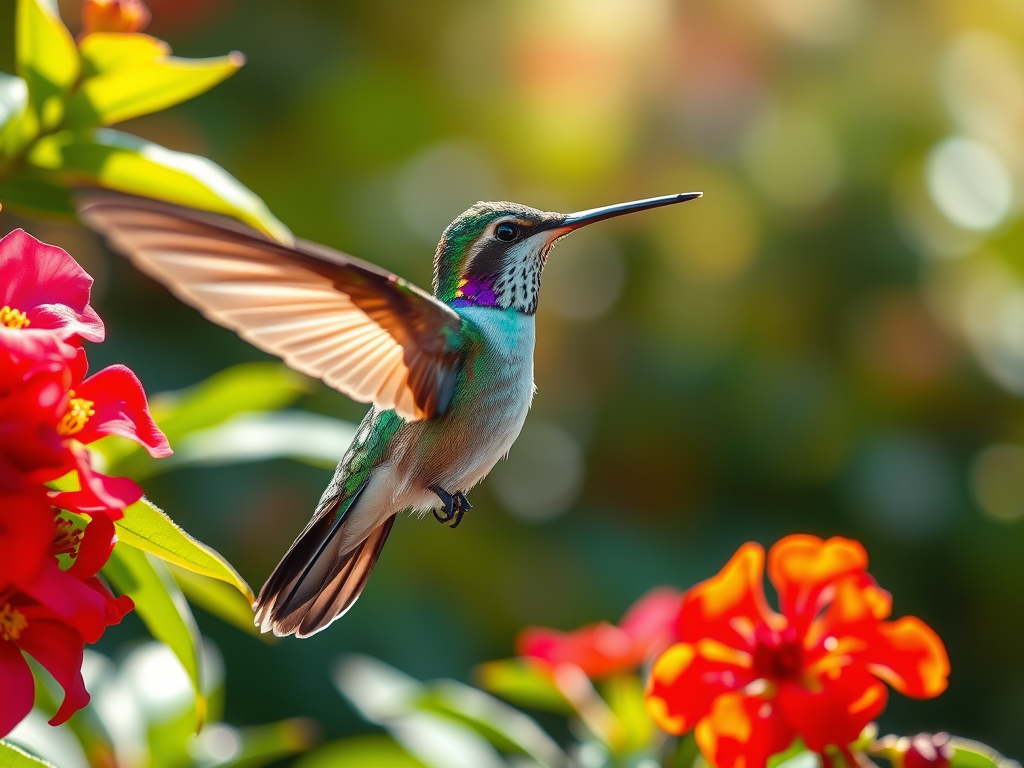
a delight in the garden
Hummingbirds are dazzling, high-octane marvels of the bird world—tiny, iridescent dynamos that can hover, fly backward, and migrate thousands of miles despite weighing less than a nickel. Their beauty and behavior are pure joy to observe, especially in California gardens where species like the Anna’s and Allen’s hummingbirds are year-round residents.
🌺 Hummingbird Highlights
- Size & Speed: Most hummingbirds weigh 3–4 grams (less than two pennies) and can beat their wings up to 80 times per second.
- Flight Mastery: They’re the only birds that can hover in place, fly backward, and even upside down briefly.
- Metabolism Marvels: With the fastest heart rate of any bird (up to 1,260 beats per minute), they must eat constantly—consuming up to twice their body weight in nectar and insects daily.
- Tongue Trickery: Their tongues are forked and spring-loaded, lapping nectar at up to 20 times per second, not sucking like a straw.
- Color Attraction: Hummingbirds are drawn to red and orange flowers, which often signal high-nectar blooms.
🍽️ What Do Hummingbirds Eat?
While nectar is their main fuel, they also rely on:
Insects and spiders for protein—especially during nesting season. Tree sap, often accessed from holes drilled by sapsuckers. Fruit flies and other small arthropods, which they catch mid-air or pluck from spiderwebs.
🏡 Backyard Tips for Attracting Hummingbirds
Plant native flowers like California fuchsia, columbine, and salvia.
Use red feeders (but skip the red dye—it’s harmful). Keep feeders clean and filled with a 4:1 water-to-sugar solution. Provide perches and water. They love shallow birdbaths and misting fountains.
🌍 California’s Common Hummingbirds Species Notable Traits Seen When?
- Anna’s Hummingbird Iridescent green with rose-pink throat (male) Year-round
- Allen’s Hummingbird Rusty-orange tones, fast and feisty Spring–Summer
- Rufous Hummingbird Fiery orange, long-distance migrant Spring migration
- Black-chinned Hummingbird Subtle coloring, buzzy wing sound Spring–Fall
🌟 Fun Fact – The bee hummingbird of Cuba is the world’s smallest bird at just 2 inches long and weighing less than a dime. In contrast, the giant hummingbird of South America can reach 9 inches!

More about the Giant Hummingbird (now this is an oxymoron)
The Giant Hummingbird (Patagona gigas) is the largest hummingbird species in the world, reaching up to 9 inches (23 cm) in length, about the size of a barn swallow and nearly five times heavier than a typical North American hummingbird. Despite its size, it retains the signature hovering ability of its smaller cousins, though with slower, more deliberate wingbeats.
🏔️ Where It Lives
Range: Found along the Andes Mountains from southwestern Colombia to central Chile and Argentina, typically at elevations between 6,500 and 13,000 feet.
Habitat: Prefers high-altitude scrublands, montane forests, and open slopes, often near flowering shrubs and cacti.
📏 Size & Appearance
Trait Giant Hummingbird (Patagona gigas)
- Length 8–9 inches (20–23 cm)
- Weight 18–24 grams (vs. 3–4g for Anna’s Hummingbird)
- Coloration Dull brownish-gray with white underparts and a faint iridescent sheen
- Bill Long, slightly curved, adapted for deep flowers
- Wings Long and pointed, nearly reaching the tail when folded
- Flight Style: Unlike the rapid wingbeats of smaller hummingbirds (up to 80 beats/sec), the Giant Hummingbird flaps its wings at a slower 10–15 beats per second, giving it a more moth-like, gliding flight.
- Feeding: Specializes in nectar from long tubular flowers, often those inaccessible to smaller hummingbirds. Also consumes insects for protein.
- Pollination Role: A key pollinator in high-altitude Andean ecosystems, especially for plants adapted to its long bill.
- Solitary & Territorial: Generally solitary and highly territorial, defending feeding areas from other hummingbirds.
❄️ High-Altitude Survival
Cold Adaptation: Survives frigid Andean nights by entering torpor, a state of reduced metabolic activity.
Oxygen Efficiency: Adapted to thin mountain air with larger lungs and hearts relative to body size.
🛡️ Conservation Status
Not currently endangered, but habitat loss and climate change pose long-term threats. Its specialized niche makes it vulnerable to environmental shifts.

How to bring Hummingbirds to your yard?
Explore the Archive

If you’re new here, this is the best way to explore the journey so far. Just click on an underlined link.

- Photo Showroom (for sale items by genre)
- My Blog Posts in chronological order
To read any of the writing listed blow press the purple button.
- Pups & Ponies Book I – fiction book – in progress here
- Doh-Rey-Me Book 1 – fiction book – written here
- Doh-Rey-Me Book 2 – fiction book – written here
- K9LTW Book 1 – fiction book – written here
- K9LTW Book 2 – fiction book – written here
- Mystery of Willow Woods – fiction short Story – written here
- The Last Signal – fiction book – written here
- Rift Guardians – fiction book – written here
- Burtt the Blade – fiction book – for sale
- Shorty’s Path – non-fiction auto biography – for sale
Bonus Fiction Feature:
If you read any of the fiction I create here to the end, you will be able to download a free digital copy when It’s complete. If I get a referral from you, I’ll throw in the fiction – Burtt the Blade. You can let me know your progress via the comment box at the end of each post.
NOTE: All photos are Mine, taken from Public Domain, or AI Generated according to my prompts. I’ll usually let you know which is which. Sometimes I forget.
Stay Connected
Get new stories and photos delivered to your inbox.

Can you see it?