I’m certainly no expert on travel to or survival on Mars but this topic does intrigue me. I dug deep into this not long ago.
NOTE: all images AI created from my prompts.


As it happens, I (we) did a study on this not long ago. If you are familiar with what I do here, I use AI assistants to deep research topics within very strict parameters of authenticity. The report generated for this topic – Mars Colonization – was informative and put a real stamp on the feasibility of not just living there, but getting there. Elon Musk be danged, but I don’t believe he’ll see it either, though he will definitely be one driving force behind the effort for some time to come.
What we discovered was that it’s going to be a bear of a project and it’s definitely a ways down the road. Still, I’ve witnessed humanity doing some truly remarkable things with the right motivation (and a deep pocket). I have to wonder though, if we’ll squander the chance to expand our reach before we finish wrecking our home. Or will we wreck it first?
Mars – can we do it?
Unlike the Moon, which is a three-day trip away, Mars is a grueling six-to-nine-month voyage across deep space. When you arrive, you aren’t just dealing with a cold, dusty desert, you’re dealing with an environment actively hostile to human biology.
Looking at the engineering reality, establishing a colony requires overcoming three massive, sequential hurdles: surviving the environment, building infrastructure, and establishing self-sufficiency.
Phase 1: The Immediate Survival Hurdles
Before any long-term building happens, the very first arrivals have to manage the daily realities of the Martian surface.
- The Radiation Problem: Mars has no global magnetic field and a razor-thin atmosphere. Colonists face high exposure to galactic cosmic rays and solar particle events. Early habitats will likely need to be buried under several feet of Martian soil (regolith) or built inside subterranean lava tubes to use the planet itself as a shield.
- Atmospheric Pressure: The atmospheric pressure on Mars is less than 1% of Earth’s. Without a pressurized suit, your bodily fluids would vaporize at room temperature.
- The Soil Toxicity: Martian dust isn’t just annoying; it’s dangerous. It contains high concentrations of perchlorates, which are chemical compounds that are highly toxic to the human thyroid and would have to be completely scrubbed from boots and suits before anyone steps inside a habitat.
Phase 2: Utilizing Local Resources (ISRU)
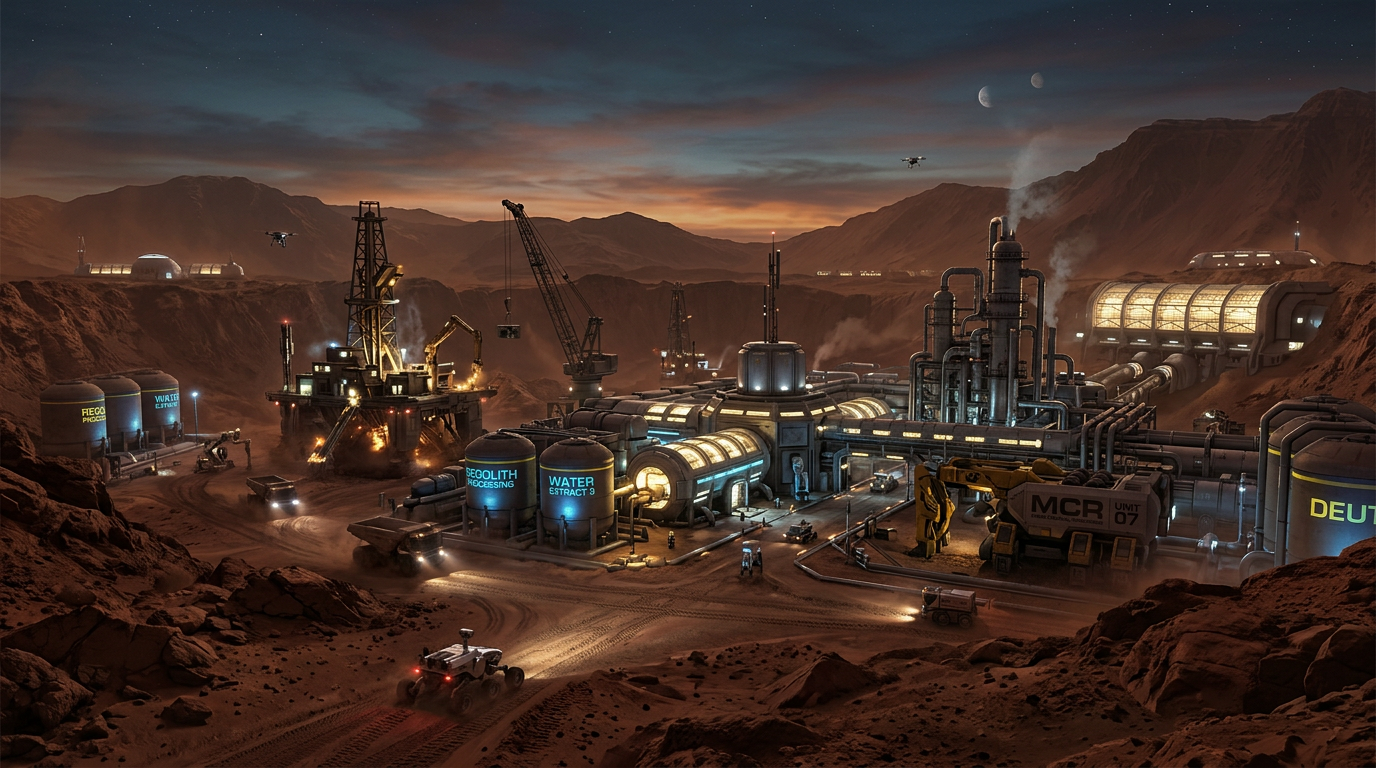
Shipping every pound of water, oxygen, and fuel from Earth is a logistical dead end. Survival depends on In-Situ Resource Utilization, or living off the land. That explains all the plans for exploration before a human makes the trip.
- Manufacturing Oxygen: The Martian atmosphere is 95% carbon dioxide. Devices like NASA’s MOXIE (which proved the concept on the Perseverance rover) can split those CO2 molecules to create breathable oxygen and carbon monoxide.
- Mining Water Ice: Mars has vast reserves of underground water ice. Automated excavators will need to mine this ice to supply drinking water, sustain indoor hydroponic greenhouse crops, and split the water H2O into hydrogen and oxygen.
- Making Rocket Fuel: By combining carbon dioxide from the air with hydrogen from mined water ice, engineers can use the Sabatier reaction to manufacture methane and oxygen. This provides the exact propellant needed to refuel starships for the return trip to Earth.
Phase 3: The Infrastructure & Energy Mix
Powering a colony requires absolute reliability. You can’t just plug into a grid, and a single system failure is catastrophic.
| Power Source | Pros | Cons |
| Solar Power | Lightweight, modular, well-understood technology. | Mars gets less than half the sunlight of Earth, and massive, months-long global dust storms can completely block out the sun. |
| Nuclear Fission | Small, compact reactors (like NASA’s Kilopower project) provide constant, 24/7 energy regardless of weather or dust. | Heavy to transport from Earth and requires handling enriched nuclear material. |
Calling Mars Home?
Here’s the real kicker. There’s always one.
The Ultimate Bottleneck: True self-sufficiency means creating a closed-loop life support system where 100% of waste, water, and air is recycled with zero loss. Until a colony can manufacture its own complex electronics, medical supplies, and heavy machinery without a shipment from Earth, it remains a fragile outpost rather than a permanent home.
Where’s Montgomery Scottie when you need a Transwarp Beaming machine?😋
Popi sends…