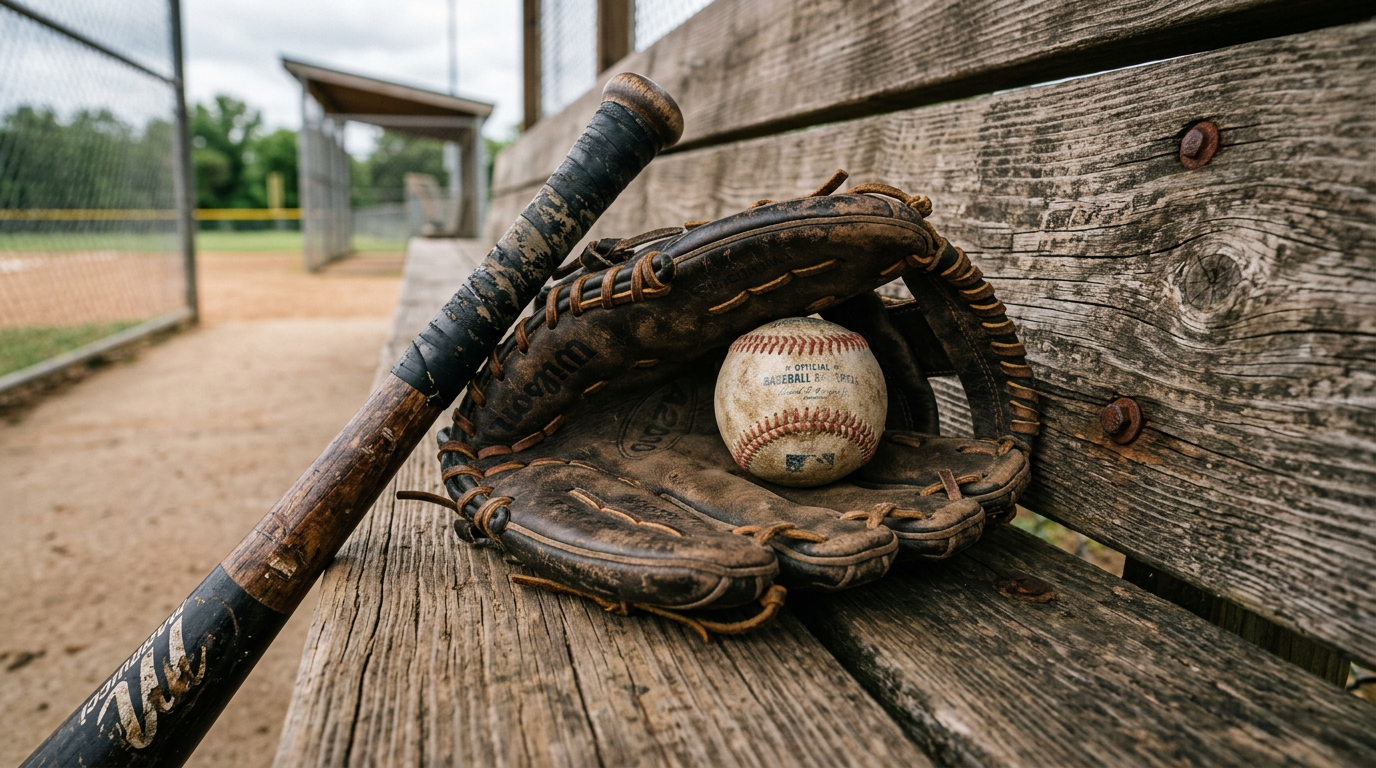
What is it about Baseball that draws us in so deeply? In 21Jul-Baseball by Popi we explore the attraction where it begins; on those dusty old sandlots, or in the streetside pick up games, and in the star-filled dreams of every soon-to-be baseball god who comes out of nowhere to capture our collective imaginations and create dreams of victory for us to cherish forever.
In the end, we find that it truly isn’t the victory that draws us in, though that surely helps for momentum going into the next game; the thrill is in the play. You can be lousy defensively for 8 and 2/3 innings, and then make that diving catch of a “screaming” line drive that ends the game and assures victory for your team. You can go 0 for 4 at the plate and then smash the walk-off hit that snatches victory from defeat. You played and you delivered. There is no greater accomplishment for a nine -year-old. This is GLORY!

21Jul-Basball by Popi
There is no clock in baseball.
That single detail sets it apart from almost every other sport on earth. Football, basketball, soccer; they are all races against a ticking clock. Time is the enemy, forcing panic, tactical stalls, and rushed decisions.
Baseball doesn’t care what time it is. A game lasts until the last out is recorded, whether that takes two hours, a whole weekend, or until the streetlights flicker on and mothers start calling from porch steps. It is a game measured not by minutes, but by possibilities. As long as you have one strike or one out left, you can still win.
That eternal promise is at the heart of why kids put on a battered glove, and why the game has taken root from the sandlots of Boston to the terrenos of the Dominican Republic, the street corners of San Juan, and the fields of Japan.
Here is what gives baseball that unique, magnetic pull across generations and borders:
- 1. The Ultimate Equalizer
You don’t need to be six-foot-six to play baseball. You don’t need to weigh 250 pounds.
Baseball honors precision, timing, hand-eye coordination, and sheer heart over brute physical size. Jose Altuve (5’6″) and Aaron Judge (6’7″) play the exact same game under the exact same rules. A kid who isn’t the fastest or the tallest in their class can still step up to a plate, find the sweet spot of a bat, and hit a ball further than anyone else.
- 2. The Language of Adaptability
Baseball isn’t defined by a stadium; it’s defined by the desire to play.
- In the Dominican Republic, kids play vitilla, using a plastic bottle cap and a broomstick, learning to hit a disc that darts and dives like a knuckleball.
- In the streets of New York, it became stickball against a stoop or a curb.
- On suburban asphalt, it’s right-field-is-foul, pitch-to-your-own-team, and a roll of black electrical tape holding together a frayed leather seam.
Baseball requires so little to exist in its purest form: something to throw, something to hit it with, and a few friends willing to run. The rules bend to the field, never the other way around.
                       THE ANATOMY OF A SANDLOT GAME

  [Streetlamp / Tree]                                [Parked Station Wagon]
     Third Base                                           First Base
         \                                                   /
          \                                                 /
           \                                               /
            \                  [Pothole]                  /
             \                Pitcher's Box              /
              \                                         /
               \                                       /
                \_____________________________________/
                               Home Plate
                         [Cardboard Box / Trash Lid]
- 3. The Camaraderie of Shared Gear
There is a unique democracy on a sandlot. Baseball is one of the few sports where the equipment is personal, yet universally shared.
You don’t share shoes in basketball, and you don’t share pads in football. But a baseball bat? A good glove? A roll of friction tape? “Here, use mine.”
When a kid hands their bat to an opponent or leaves their glove on the mound for the other team to use in the bottom of the inning, an unspoken contract is formed. It teaches generosity before competition. It says: The game is more important than the rivalry.
- 4. The Geometry of Hope
Every baseball field, whether it’s Fenway Park or a neighborhood gravel pit, opens outward into infinity. The foul lines extend forever. “…and it rolls all the way to the wall…”
                          \                 /
                           \   INFINITY    /
                            \             /
                             \   OUTFIELD/
                              \         /
                               \  IN-  /
                                \FIELD/
                                 \   /
                                  \ /
                                 [H.P.]
Because there is no clock, there is always room for a miracle. You can be down by ten runs with two outs in the ninth inning, and the opposing team still has to pitch to you. They can’t run out the clock. They have to throw the ball over the plate and make you fail. That structural requirement gives baseball an extraordinary narrative arc, one where redemption is always one swing away.
5. Failure and Resiliency
Baseball is a game of failure. The absolute best hitters in the history of the sport, from Ted Williams on down, failed six or seven out of ten times.
It teaches kids a quiet, tough resilience that few other games can match:
- You strike out? You walk back to the bench, put your helmet away, and get ready to play defense.
- You get slaughtered today? “Tomorrow we’re gonna slaughter them.”
It mirrors life more closely than almost any other sport. It’s about how you handle the strikeout, how you adjust your grip when the cover comes off the ball, and how you show up the next morning ready to pick up right where you left off.
“It breaks your heart. It is designed to break your heart. The game begins in the spring, 50 days when everything is leaves and blossoms, when everything opens up and offers itself, and it runs through the summer, fruits and growth, and then as the chill takes a hold, forces the ultimate crisis, you are left to face the dark, and winter.”
— A. Bartlett Giamatti, former MLB Commissioner
Ultimately, baseball stays with us because it bridges the past and the present. When you put on a glove today, you are using the same basic body mechanics that kids used in 1960, in 1920, and in 1890. It links generations, parents to children, grandfathers to grandsons in a timeless, clockless loop where it is always summer, and there is always one more at-bat waiting for you.
As always – be well, be alert, be informed. Popi sends…
Look for 👉Popi’s UnSpun News👈 in your mailbox with a free subscription.
…or…
Slide over 👉here👈 for a photo show instead