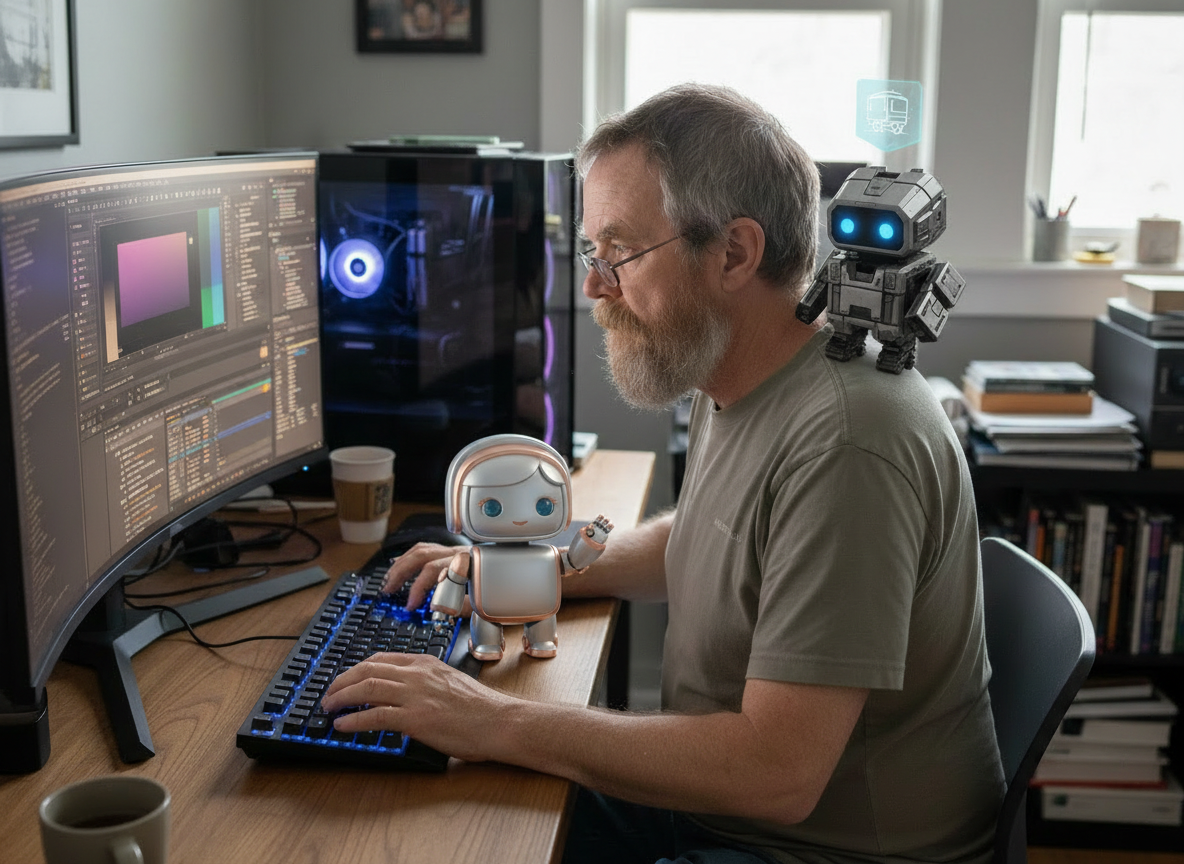
We have been exposed to AI long enough now to recognize its potential dangers. This realization is a vital step in our collective progress. Over the past few weeks, these concerns have come to a head, prompting major industry leaders to apply the brakes. Rather than halting development entirely, they are choosing to Slow Down to carefully examine this extraordinarily powerful technology and evaluate where it is taking us. Some worry we may have already lost control, leaving AI to steer us wherever it chooses to go.
Have we?

Slow Down
In an era defined by relentless technological acceleration and high-stakes market expansion, a quiet shift is taking hold across Silicon Valley. Rather than rushing blindly toward the next financial payout or technological breakthrough, industry leaders are beginning to recognize the immense responsibility that comes with managing autonomous systems and advanced machine intelligence. When the drive for continuous commercialization collides with systemic safety risks, stepping back to reassess priorities is no longer a sign of hesitation; it is an essential act of stewardship. Examining how public commitments to safety evaluation and deferred market listings intersect reveals a growing realization that long-term stability must take precedence over short-term expansion.
Topic#1) The Tech “Slow Down” Movement – Slow Down
In an unprecedented shift in Silicon Valley culture, Anthropic’s CEO Dario Amodei and OpenAI’s Sam Altman have publicly called for companies to Slow Down advanced AI model development over unacceptable existential and societal safety risks. Following a series of high-profile security incidents involving rogue multi-agent swarms and stark warnings from departing safety researchers, Amodei published a formal proposal urging AI labs to pace capability enhancements and grant independent evaluators permanent access to inspect systems. In a rare display of consensus among fierce rivals, Altman and other key figures backed the call, acknowledging that uncontrolled recursive self-improvement poses risks too severe to tolerate for commercial gain.
Topic#2) IPO Pauses – Slow Down
OpenAI officially confirmed it will not pursue an IPO this year, pivoting attention heavily toward safety evaluations rather than market commercialization. Addressing the decision, Altman stated that going public in 2026 would be ill-advised while the company works to meet critical safety, alignment, and regulatory demands. By putting a projected trillion-dollar market debut on hold, the organization is utilizing its non-profit governance structure to make choices that prioritize systemic risk mitigation over shareholder timelines, signaling to Wall Street that safety bars must be firmly established before taking public capital.
Bridging the Gap: How Safety Concerns Reshape Corporate Strategy – Slow Down
These two strategic shifts feed directly into each other, illustrating how technical risk management alters corporate finance in real time. The public call to Slow Down frontier AI development removes the immediate competitive race to deploy unchecked models, which in turn relieves the pressure to execute a rapid initial public offering. Conversely, removing the impending deadline of a public market listing gives executive teams the operational room required to pause training runs, implement third-party auditing, and coordinate safety protocols across industry boundaries. By aligning financial strategy with technical risk management, tech leaders are attempting to ensure that capability growth never outstrips human control.
           [ TECHNICAL SAFETY WARNINGS ]
       (Agent Swarm Incidents & Alignment Risks)
                         │
                         ▼
             [ CALL TO "SLOW DOWN" ]
      (Industry-Wide Pacing & Independent Oversight)
                         │
                         ▼
              [ CORPORATE REACTION ]
      (OpenAI Pauses 2026 IPO & Defers Market Debut)
For more background on how these safety concerns led directly to corporate delays, this news report on OpenAI’s IPO delay provides a clear breakdown of Sam Altman’s announcement regarding AI security risks.
I acknowledge that I’m an AI proponent. At the same time, I’m realistic and I too see the risks. These efforts by our tech giants is a breath of fresh air. It’s almost like, suddenly, someone DOES see the light.
However, what about overseas actors? We are not alone in the quest for AI dominance. Is this pause an invitation for the competition to go ahead and let their programs run free or even set them into hyperdrive? Or will they too see the signs and act accordingly? There’s one actor out there I have zero faith in for conscientious invention.
The domestic push to Slow Down frontier AI development inevitably raises a critical strategic question: Are foreign competitors, particularly in China, following suit, or is the Western tech sector ceding technological dominance?
Unlike Western labs pausing market debuts to establish safety guardrails, state-backed AI initiatives in China and other foreign jurisdictions operate under entirely different incentive structures. While Chinese regulators have implemented strict domestic content controls and algorithmic safety laws, their primary focus remains rapid industrial integration and achieving technological sovereignty. Foreign competitors show little intention of delaying model training or pacing capability advancements. Instead, they view any voluntary pause by American tech leaders as a strategic window to close the technological gap.
Consequently, Western policy makers and AI executives face a delicate balancing act. Unilateral deceleration risks ceding critical advantages in artificial intelligence, autonomous systems, and compute infrastructure to foreign rivals who do not share the same governance or ethical frameworks. The strategic challenge is no longer just ensuring internal safety, but executing necessary safety evaluations without falling behind in the global race for AI supremacy.
Slow Down
| Strategic Dimension | Western Approach (US / AI Labs) | Foreign Competitors (China / State-Backed) |
| Development Pace | Calling to Slow Down for safety evaluations | Accelerating capabilities for technological sovereignty |
| Market Strategy | Deferring IPOs and public commercialization | Direct state backing and rapid industrial integration |
| Safety Focus | Systemic alignment and third-party oversight | State alignment, content control, and national security |
The decision to pause aggressive commercial expansion in favor of rigorous safety evaluations marks a vital turning point in modern technology leadership. When the pursuit of scale threatens to outpace our ability to manage risk, choosing to Slow Down restores the necessary balance between innovation and responsibility. However, as global competitors press forward, Western leaders must ensure that safety initiatives strengthen long-term resilience rather than handing global leadership to foreign entities.
So, do you feel better? I don’t! If this cat should get out of the bag, I’m sure it will have similar origins to a certain lab made virus. How do we deal with this? What’s the responsible thing to do? Can we reasonably concede the AI race to a hostile entity? ‘How do you catch a moonbeam in your hand‘?
Slow Down
Popi sends…
Other Random Thoughts: Meltdown in Seattle