
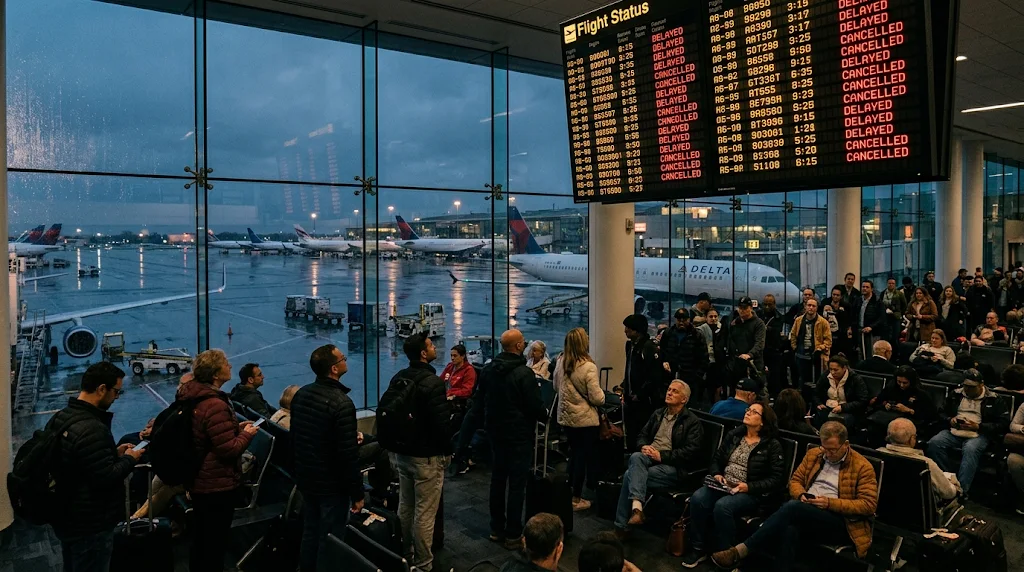
Ground Stop is a phrase that immediately sends a jolt of anxiety through travelers, logistics coordinators, and aviation officials alike. When the Federal Aviation Administration issues a ground stop, planes are held at their departure gates, runways sit eerily quiet, and thousands of passengers are left staring at terminal departure boards wondering what went wrong. While minor localized ground stops happen frequently due to severe thunderstorms or temporary runway congestion, nationwide or major-carrier halts point to deeper systemic vulnerabilities in modern air travel. Examining the operational mechanics, technical triggers, and broader fallout of a major ground stop reveals just how fragile our tightly synchronized aviation infrastructure really is.
Ground Stop
What a Ground Stop Actually Means in Aviation
In strict aviation terminology, a ground stop is a traffic management initiative implemented by the Federal Aviation Administration (FAA) Air Traffic Control System Command Center. Unlike a ground delay program, which spaces out departures to manage expected congestion at a destination airport, a ground stop completely halts aircraft destined for a specific airport, airspace sector, or entire carrier network from taking off. Planes already in the air are permitted to continue to their destinations or divert to alternate hubs, while aircraft still on the tarmac remain locked in place.

Aviation authorities deploy this measure only when conditions make safe, orderly air traffic management impossible. Common triggers fall into three primary categories:
- Severe Weather Events: Thunderstorms, low visibility, heavy icing, or high crosswinds that reduce airport arrival acceptance rates to zero.
- Airspace and Runway Emergencies: Disabled aircraft blocking primary runways, security breaches inside terminal perimeters, or medical emergencies requiring immediate ground priority.
- Systemic Technical and Staffing Failures: Outages in air traffic control radar, flight-plan processing databases, airline dispatch software, or sudden shortages in certified air traffic controllers.
What happened on November 13, 2026?
Anatomy of a Systemic Aviation Breakdown – Ground Stop
When a ground stop moves beyond a single storm-battered hub and freezes major airline networks or national airspace, the root cause almost always traces back to legacy technology colliding with modern operational complexity. Modern commercial aviation relies on an intricate web of interconnected digital systems. Before a single commercial airliner can push back from the gate, airline dispatchers must file electronic flight plans, calculate precise fuel loads, verify weight and balance manifests, and confirm pilot crew legality. Simultaneously, FAA systems must process those flight plans, distribute Notice to Air Missions (NOTAM) safety alerts, and coordinate routing across regional air route traffic control centers.
Because these systems operate on razor-thin margins, a single point of failure quickly triggers a cascading paralysis across the entire network:
- The Initial Glitch: A corrupted database file, a failed server update, or a third-party telecommunications outage disrupts communication between airline dispatch centers and air traffic control.
- The Safety Freeze: Without verified safety alerts, weather data, or weight-and-balance calculations, federal regulations strictly prohibit aircraft from departing. The FAA or the affected airline initiates an immediate ground stop to prevent mid-air congestion and unverified routing.
- The Crew and Gate Domino Effect: Even after engineers resolve the underlying software or hardware failure, operations cannot simply flip a switch and resume normal schedules. Flight crews quickly exceed their federally mandated maximum duty hours while waiting on the tarmac, outbound planes remain trapped at gates blocking incoming flights, and aircraft end up stranded in the wrong cities.
| Operational Phase | Primary Bottleneck | Downstream Passenger Impact |
| Immediate Halt | Safety alerts or dispatch links fail; takeoffs frozen | Passengers held on tarmacs or crowded into terminal gates |
| System Recovery | Software rebooted, but backlog of flight plans spikes | Rolling delays as air traffic control meters departures |
| Network Reset | Crews time out; aircraft displaced from hub rotations | Multi-day cancellations and lost baggage across national hubs |
The Vulnerability of Centralized Infrastructure – Ground Stop

Looking closely at major aviation disruptions highlights a troubling reality about modern infrastructure: efficiency has been prioritized at the expense of resilience. Over the past two decades, major airlines and federal aviation agencies have consolidated server architectures, outsourced critical telecommunications backbones, and stretched staffing rosters to maximize capacity. While this hyper-efficient model keeps ticket prices competitive and routes packed during smooth weather, it leaves virtually zero buffer when an unexpected technical fault occurs.
Furthermore, much of the foundational software governing air traffic control and airline crew scheduling still relies on aging legacy code patched together with modern cloud interfaces. When an unscheduled update or hardware failure strikes one layer of that stack, backup systems often fail to transition seamlessly. Rather than isolating the problem to a single regional hub, centralized dispatch platforms transmit the failure coast-to-coast within minutes. For travelers, business supply chains, and emergency air freight, a two-hour computer outage can easily spiral into forty-eight hours of national logistical chaos.
Navigating the Future of Air Traffic Reliability – Ground Stop
Preventing future nationwide paralysis requires more than temporary patches or routine congressional hearings after the terminals finally clear. Aviation regulators and major carriers face mounting pressure to modernize air traffic control infrastructure, build true decentralized redundancy into flight-dispatch networks, and address persistent air traffic controller staffing shortages. Until those structural upgrades move from budget proposals to operational reality, the traveling public remains vulnerable to sudden, system-wide freezes.

Ground Stop
A Ground Stop serves as a stark reminder that even the most advanced transportation network in the world depends entirely on the reliability of the invisible systems working behind the scenes. While federal aviation rules rightly prioritize safety above schedule convenience, the recurring vulnerability of critical communication and dispatch infrastructure demands serious accountability. Ensuring that planes stay safely in the sky requires building resilient, redundant systems on the ground before the next warning light flashes across the control room.
All this reminds me of why I’m not so upset at my lack of travel to distant lands…but, man, I wish I could.
Popi sends…
Other Random Thoughts: Nvidi-uh-oh!




Can you see it?