
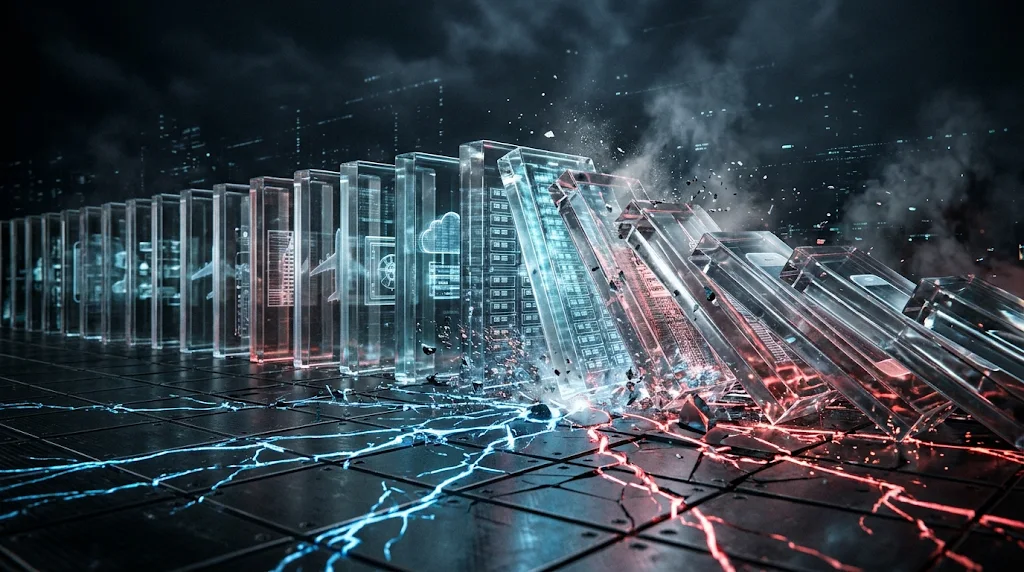
I take great pride in the fact that I broke this story Cascading Systemic Failures before anyone else. Sure, sure, the MSM reported the individual incidents and went along with the vanilla flavored responses from all involved that the failures were not connected or the result of malicious attack. Now, they are all scrambling to report what I reported Two full days ago. Ahem!!!!! Tech giants are scouring their code and hardening their networks. Moms across the country are stockpiling T-paper and Vodka. Teenagers and most engineers are home playing Grand Theft Auto (version [672 * the square root of pi])
Remember – Gibbs and I told you, there’s no such thing as a coincidence. Nope! No sir! There sure aint.
Note: I changed the title from the previous article slightly to fool my SEO watch dogs, while in keeping with the subject trail.
Cascading Systemic Failures
Systemic Cascading Failures: Connecting the Dots Before the Mainstream Media Woke Up
Systemic Cascading Failures was not a buzzword on network television or front-page cable news crawls when we first connected the dots earlier this week. While mainstream newsrooms were busy treating a Microsoft cloud glitch, a Federal Aviation Administration ground stop, a JPMorgan Chase banking freeze, and a National Security Agency network blackout as four isolated, unrelated accidents, we stepped back, looked at the bigger board, and called it exactly what it is. It is satisfying to watch the legacy press finally catch up to the big picture, even if it took seven days of rolling chaos across cloud software, aviation, finance, payroll systems, and intelligence networks for them to realize these breakdowns belong in the exact same conversation. Now that the rest of the media ecosystem is scrambling to connect the threads we laid out days ago, it is time to update our report with the latest developments through Thursday, November 19, 2026, examine the newly added dominoes, and ask the hardest question of all: Are these incidents tying together more tightly, or are we still expected to swallow the “pure coincidence” line?

The Expanding Domino Chain: What Has Happened Since Our First Report – Cascading Systemic Failures
When we published our initial breakdown on Tuesday, November 17, four pillars of modern infrastructure had already buckled inside six days. Over the past 48 hours, the list of disrupted critical systems has grown even longer, and official post-mortems have introduced fresh contradictions that raise more questions than they answer.
- Thursday, November 12 (Microsoft 365 Cloud Paralysis): Microsoft has now released its preliminary post-incident report (under incident IDs EX1550543 and MO1550821), confirming that a latent software defect introduced during a July 2026 network capacity upgrade knocked more than 80 percent of its networking gateway servers offline for nearly 24 hours. Routine maintenance reduced gateway fleet capacity by 14 percent alongside a traffic allocation shift, awakening the dormant code and triggering a cascade where backed-up traffic repeatedly crashed recovering servers. A final engineering report is scheduled for Friday, November 20.
- Friday, November 13 (The FAA Nationwide Ground Stop and 911 Glitches): What started as an afternoon communications breakdown in Texas and Arkansas forced a rare four-hour-and-25-minute shutdown of the National Airspace System, grounding thousands of departures and halting transatlantic flights from 42 Eurocontrol member states. Around the same window, Downdetector logged sudden spikes in 911 emergency call disruptions across multiple states. While early briefings pointed directly to contractors swapping 1960s-era copper wiring for fiber optics and Juniper routers, FAA Administrator Bryan Bedford and Transportation Secretary Sean Duffy muddied the waters today, November 19. Speaking in Washington, FAA leadership now insists the ground stop had “nothing to do” with ongoing air traffic management modernization efforts, even though the agency disabled routing features on more than 60 Juniper units and halted installations nationwide.
- Friday Night, November 13 to Saturday, November 14 (The Workday Payroll Blackout): Quietly tucked behind the FAA headlines, enterprise human-resources and payroll giant Workday suffered a major outage affecting over 11,500 organizations after a disaster-recovery backup test accidentally connected to live production databases.
- Monday, November 16 (JPMorgan Chase, U.S. Banks, and United Airlines): Millions of customers across JPMorgan Chase, Bank of America, Wells Fargo, U.S. Bank, Truist, Capital One, and Zelle faced frozen balances and failed transfers after what Chase described as a software bug inside its on-premises hardware systems. Because Chase serves as a primary interbank clearinghouse, its internal bottleneck rippled across the entire American banking grid, dragging JPMorgan stock down 2.3 percent on the day. Simultaneously, United Airlines experienced a separate software failure across its crew apps and aircraft weight-and-balance tools, delaying hundreds of flights.
- Tuesday, November 17 to Wednesday, November 18 (NSA, Apple, Charles Schwab, and Gmail): Just hours after the National Security Agency enacted a “Code Yellow” staggered reporting posture at Fort Meade because its classified NSANet communications backbone went dark, consumer and financial tech stumbled again. Around midday Tuesday, Apple suffered widespread outages across iCloud, Apple Pay, the App Store, and AppleCare due to what it called an “internal update,” freezing in-store transactions in New York and Chicago. Charles Schwab temporarily lost its trading website, and thousands of Gmail users reported delayed or missing messages, though Google denied a broad platform failure.
Updated Timeline of the November 2026 Infrastructure Wave – Cascading Systemic Failures
| Date (Nov 2026) | Affected System or Agency | Operational Fallout | Official Explanation | Suspicious Red Flags |
| Thu, Nov 12 | Microsoft 365 | 80%+ gateway servers unresponsive for ~24 hours globally | Dormant July 2026 code defect awakened by maintenance capacity drop | Latent flaw sat undetected for 4 months across global cloud |
| Fri, Nov 13 | FAA Airspace & 911 | 4h 25m nationwide ground stop; 10,000+ flights disrupted; 911 busy signals | Telecom data flood; Juniper router feature disabled on 60+ units | FAA Chief now denies link to modernization despite halting router work |
| Fri, Nov 13 | Workday | Payroll and HR blackout across 11,500+ organizations into Saturday | Disaster-recovery test accidentally linked to production databases | Occurred hours after FAA collapse during peak Friday payroll runs |
| Mon, Nov 16 | JPMorgan Chase & Banks | Frozen accounts and stalled interbank/Zelle transfers nationwide | Software bug in Chase on-premises hardware systems | Single bank bug cascaded across competing national banks |
| Tue, Nov 17 | NSA (NSANet) | Classified internal network offline; Fort Meade staggered arrival | “Temporary degradation during scheduled routine maintenance” | Happened during tense APEC summit diplomacy; forensic rush |
| Tue, Nov 17 | Apple & Charles Schwab | iCloud, Apple Pay, App Store, and Schwab brokerage web portal down | Apple cited an “internal update”; Schwab resolved web fault | Struck within hours of NSA blackout and one day after bank freeze |
Is It Tying Together More Tightly, or Still Just “Coincidence”? – Cascading Systemic Failures

On paper, every single corporation and federal agency involved has issued the exact same reassuring mantra: there is zero evidence of a coordinated cyberattack, no foreign adversary breached the perimeter, and each failure has a separate, boring internal cause. Officials from Microsoft, JPMorgan Chase, Apple, the FAA, the NSA, and Director of National Intelligence Jay Clayton have all insisted the incidents are completely unrelated. Even Fox News and mainstream tech analysts have pivoted today toward framing the week as a lesson in “disaster recovery” rather than external warfare.
Yet when you step back from the individual press releases, the events are tying together in two unmistakable ways. First, structurally, they prove that modern civilization has become a single, tightly coupled machine where localized failures do not stay local. When JPMorgan Chase sneezes, Bank of America and Zelle catch a cold. When a contractor tweaks a router in Texas and Arkansas, transatlantic flights out of Europe are grounded. When Microsoft reduces gateway capacity by 14 percent, global healthcare and government workflows grind to a halt.
Second, politically and rhetorically, Washington’s own leadership cannot even keep its story straight. While DNI Jay Clayton and President Trump urge calm and dismiss conspiracy theories, Homeland Security Secretary Markwayne Mullin raised eyebrows across Washington this week by openly speculating on television that “super intelligence” or aging legacy systems could be behind the wave of disruptions, even as he claimed to be “98 percent sure” it was not a traditional cyberattack. Meanwhile, Transportation Secretary Sean Duffy admitted he still lacks full “clarity” on what triggered the FAA breakdown, and FAA Administrator Bryan Bedford directly contradicted earlier briefings by claiming modernization work was not to blame.
What New Details Make the Picture More Suspicious? – Cascading Systemic Failures

Even if you reject wild theories of a single Hollywood-style super-hacker flipping a master switch, several concrete developments over the past 48 hours make the official “nothing to see here” narrative far harder to accept at face value:
- The Speed of the “Not a Cyberattack” Clearances: Cybersecurity veterans and national security analysts are increasingly vocal about a glaring forensic impossibility. Within hours of the FAA ground stop, the Chase bottleneck, and the NSA network degradation, spokespeople confidently announced that malicious activity had been ruled out. As security experts noted following the NSANet blackout, genuine root-cause forensics on complex, classified, or nationwide networks takes weeks or months, not three hours before the evening news cycle. Ruling out intrusion before full logs are even parsed looks less like verified science and more like reflexive damage control to prevent market panic and bank runs.
- The Geopolitical Timing Window: Every one of these breakdowns unfolded during one of the most delicate diplomatic weeks of 2026. President Trump has been overseas in Asia, culminating in today’s historic November 19 trilateral summit in Shenzhen with Chinese President Xi Jinping and Russian President Vladimir Putin over nuclear arms control, Ukraine, and the active conflict with Iran. Having America’s commercial cloud, national airspace, largest clearinghouse bank, and premier signals intelligence network stumble sequentially while the Commander-in-Chief is sitting across the table from Beijing and Moscow is either the worst luck in modern history or a subtle demonstration of asymmetric leverage.
- Contradictory Cover Stories at the FAA and NSA: On November 15, the FAA’s official Q&A explicitly pointed to Juniper router replacement work in Texas and Arkansas, noting it had disabled a routing feature on more than 60 routers and paused installations. Four days later, on November 19, the FAA Administrator stood before reporters and declared the ground stop had “nothing to do” with modernization efforts. Similarly, the NSA initially enacted an emergency “Code Yellow” staggered arrival posture for tens of thousands of Fort Meade employees and rerouted traffic to alternate facilities, only to issue a bland statement claiming the outage was merely “scheduled routine maintenance.” Agencies do not put top-secret intelligence headquarters on emergency staggered reporting postures for routine Tuesday maintenance.
- The “Super Intelligence” Slip and Unexplained Latent Bugs: Homeland Security Secretary Markwayne Mullin’s unscripted remark suggesting “super intelligence” could be a factor, paired with Microsoft admitting a critical flaw sat dormant inside its core cloud architecture since July without triggering a single alarm, points to a chilling possibility. Whether driven by autonomous AI coding tools pushing flawed updates faster than human engineers can audit them, or quiet probing attacks testing how fast American infrastructure buckles under stress, human operators are visibly losing visibility into the systems they supposedly control.
Cascading Systemic Failures
Living on a Tightrope Without a Net – We spotted the pattern of Systemic Cascading Failures before the mainstream press could even spell the phrase, and everything that has transpired over the past two days only reinforces our original warning. Whether the root driver is reckless corporate software deployment, decaying federal infrastructure, autonomous AI tools introducing silent bugs, or covert probing by adversaries who know exactly where our digital seams are stitched, the practical outcome is identical. Our banking, aviation, cloud, and intelligence grids have been engineered for maximum speed and zero slack. Until leaders stop hiding behind hasty “no cyberattack” press releases and start rebuilding true, decentralized resilience, the next domino is always one bad software patch away from falling.
Popi sends…
Other Random Thoughts: Relevance




Can you see it?