
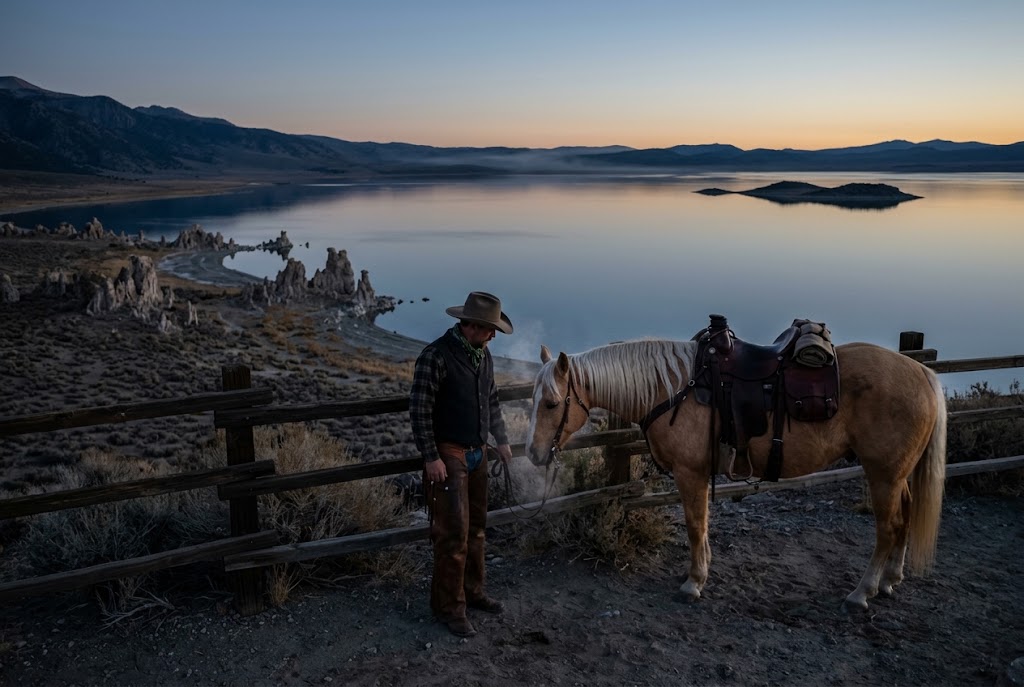
The history of this area goes back so far even I don’t remember. 😕 On this leg, Virginia Lakes to Mono Lake, we visit Mono Lake – one of the oldest lakes in North America, one million years maybe. Native Americans and white settlers used the land for their own needs, one for life, the other for greed – or progress – depending on whose story you prefer. Either way, today, the lake and the area are thriving tourist spots and the lake is doing just fine.
NOTE: We are stretching the truth a bit this time. The nearest horse accessible camping with water is 34 miles south of Lee Vining on highway 395. Dispersed camping with stock is permitted on public USFS lands south and east of Mono Lake, but you have to haul your own water and feed. There are facilities near Virginia Lakes Road, where we came out of the wilderness earlier in the day. For our story, we’re camping along side the Lee Vining Creek bed between the Visitor Center and the tiny Lee Vining Airport. I’m also making assumptions that along the way, I can acquire feed for Sierra, and that there’s readily available water too. It’s true in some places, but perhaps not everywhere I’ve made the assumption.
Virginia Lakes to Mono Lake

Virginia Lakes to Mono Lake – a descent like no other.
The early morning high-country air carries an unforgiving frost, thick with the scent of frozen lodgepole needles, bitterbrush, and the sharp, metallic tang of an approaching Sierra blizzard. Sitting deep in a dark, oiled Wade saddle packed with a canvas bedroll, woolen slicker, and leather saddlebags, a rider feels the rhythmic, muscular cadence of Sierra, a strong-boned golden palomino. Her winter coat catches the icy mountain breeze, and her long, almost white mane whips lightly across her neck as she steps out onto the hard-crusted trail. Clad in heavy tapaderos, leather chaps, a wool vest over heavy flannel, a silk wildrag, and a wide-brimmed felt hat, a seasoned rider moves with quiet confidence across the eastern escarpment of the Sierra Nevada. It is just horse and rider today, carrying the same lightened load as previous legs, striking out on the long descent from the high granite cirque of Virginia Lakes down toward the vast, ancient basin of Mono Lake.
The Descent Through Virginia Creek Canyon – Virginia Lakes to Mono Lake

Leaving the high shores of Big Virginia Lake at an elevation above ten thousand feet, the route heads northeast, following the rushing course of Virginia Creek as it carves through a steep glacial canyon. The trail here is hard-packed, strewn with loose granite gravel and basalt talus that shifts underfoot. Sierra moves with deliberate patience, her iron shoes making a sharp clink-clink against the frost-covered stone as she picks her way over step-overs and water bars. To the north, the massive, dark shoulders of Dunderberg Peak loom high against the pale autumn sky, while to the south, the granite flanks of Black Mountain cast long, cold shadows across the trail.
As the elevation drops steadily through Lower Virginia Creek, the dense lodgepole pines give way to golden groves of quaking aspen, their remaining leaves trembling in the wind. The trail pushes down past the lower primitive campgrounds, where the creek widens over dark, mossy boulders. Up here, wildlife remains vigilant before the snows close the passes; a herd of mule deer browses along the willow thickets, and a solitary red-tailed hawk circles high on the thermal updrafts rising from the valley floor. Leaning back slightly in the Wade saddle to take the strain off Sierra’s shoulders, the rider guides her through sharp, gravelly switchbacks as the mountain wall begins to flatten into the high-desert transition zone.
Navigating the Basin Bench and Lundy Canyon Moraines – Virginia Lakes to Mono Lake

Passing the base of the mountains near 7,000 feet, the trail turns northward along the sweeping alluvial benches framing the eastern Sierra front. The path crosses cold mountain runs fed by Lundy Canyon and Virginia Creek before rounding the long, sweeping moraine ridges south of Mono City. To the west, the deep, dark notch of Lundy Canyon cuts far back into the granite crest toward Gilcrest Peak and Mount Warren, its upper basin hidden under swirling grey clouds.

Crossing open sagebrush flats near the Mono Basin Interagency Fire Station, the wind picks up dramatically. Sierra’s ears prick forward as the vast, inland sea of Mono Lake opens up ahead, its dark blue, alkaline waters stretching out for miles against the barren backdrop of Paoha and Negit Islands. The footing along this lower bench shifts from mountain granite to loose, volcanic sand and fine pumice gravel. Sierra’s hooves sink slightly into the pale soil, but her steady, tireless gait carries the pair past the sage flats and around the wide, winding curves of the lower basin road.
Arrival at Mono Basin Scenic Area Visitor Center – Virginia Lakes to Mono Lake

Tracking north-northwest along the ancient shoreline terraces, the trail climbs a gentle rise just above the lake margin, arriving at the Mono Basin Scenic Area Visitor Center located just north of Lee Vining. The timbered structure sits on a high bluff overlooking the water, offering a commanding vista of the entire basin and the jagged Sierra crest towering behind it.

Pulling Sierra to a halt near the corral facilities, horse and rider dismount after nearly sixteen demanding miles of continuous descent. Resting a gloved hand on the Wade saddle horn, the rider checks Sierra’s legs and hooves, loosening the cinch so the golden mare can catch her wind. Her warm breath plumes white in the cold desert air as she shakes out her long white mane, eager for water and hay. Here at the visitor center, horse and rider will spend the night, the entire next day, and a second night resting and resupplying. Pack bags will be replenished, shoes checked, and rations restocked before turning back west toward the high granite passes of the Sierras for the return journey into Yosemite.
History of Mono Lake and Lee Vining – Virginia Lakes to Mono Lake
The Mono Basin is one of the oldest lakes in North America, estimated to be at least one million years old. Because it has no natural outlet, salts and minerals washed down from the surrounding mountains have accumulated over millennia, making the water nearly three times saltier than the ocean and extremely alkaline. This unique chemistry supported a vast ecosystem centered on alkali flies and brine shrimp, which in turn fed millions of migratory birds. The area’s original human inhabitants, the Kutzadika’a People (a northern Paiute group), derived their name from the nutritious alkali fly pupae they harvested along the lake’s shores.


The neighboring town of Lee Vining owes its origins to Leroy Vining, a prospector who led a group of miners over Tioga Pass in 1852 during the California Gold Rush. Vining established a sawmill along what is now Lee Vining Creek to supply timber to the booming mining camps at Lundy and Bodie. In the 20th century, Mono Lake became the focal point of a historic environmental battle when the Los Angeles Department of Water and Power began diverting its tributary streams in 1941, causing the lake level to drop precipitously and exposing the famous tufa towers – strangely shaped limestone formations created by underwater freshwater springs. Decades of grassroots conservation efforts eventually led to public protection and water restoration mandates that preserve this ancient basin today.
Sitting on a sun-warmed bench at the visitor center as the twilight turns the sky to deep violet, watching the shadows of the Sierra crest lengthen across the tufa towers of Mono Lake, the sheer endurance of the land settles deep into the spirit. Resting up in this ancient desert sanctuary, horse and rider prepare for the cold, high-altitude trail that awaits them when they turn back toward the mountains. But first, a time of rest, rehabbing tired legs, feeding like the end was near, enjoying the quiet, and finally – preparing for the journey ahead.

continued in: Natives-Mining-Water
what came before: Green Creek to Virginia Lakes
from the start: High Country
Virginia Lakes to Mono Lake
Popi sends…
Popi’s Random Thoughts: Quick Takes & Opinions



Can you see it?