
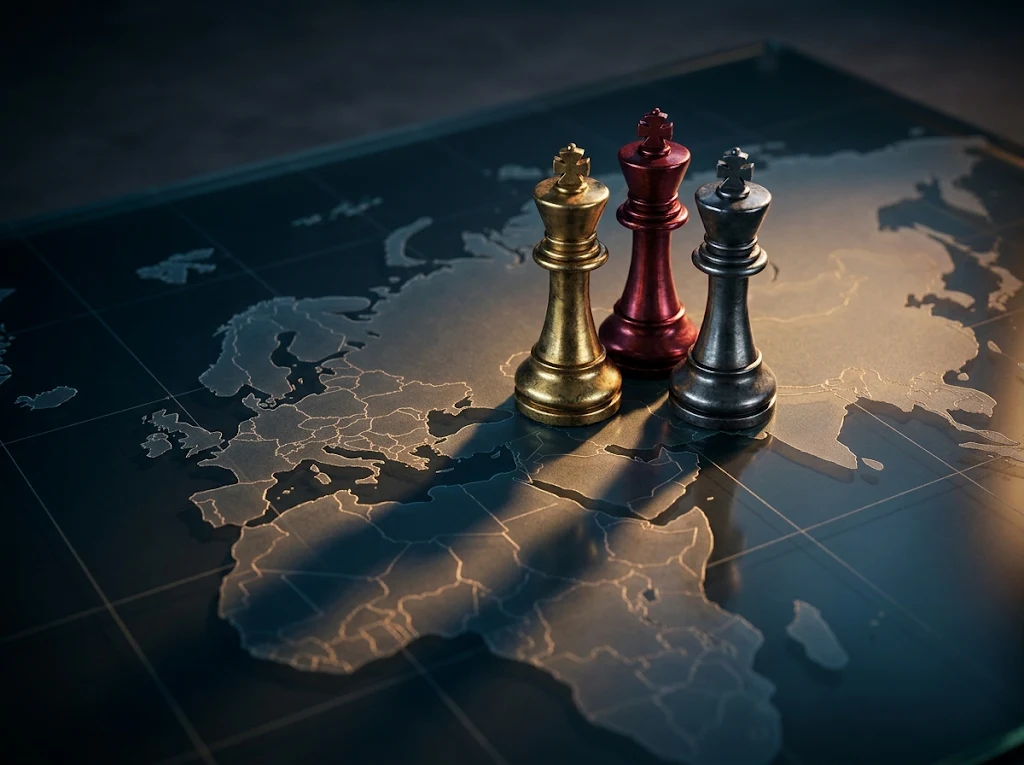
Three-Way Power Play in Shenzhen has captured the full attention of global capitals this week as U.S. President Donald Trump, Chinese President Xi Jinping, and Russian President Vladimir Putin gather on the sidelines of the Asia-Pacific Economic Cooperation (APEC) summit in China. While each pair of leaders has met individually many times over the years, the three men have never sat down together in a formal trilateral format. Today, Wednesday, November 18, 2026, Trump arrived in Shenzhen to a personal airport welcome from Xi, followed by informal encounters and handshakes ahead of the APEC welcome banquet before their formal one-hour trilateral sit-down scheduled for Thursday, November 19. Surrounding that historic table is a fierce battle over nuclear weapons, active wars in Ukraine and Iran, global trade, and the future role of Europe in a rapidly shifting international order.
Three-Way Power Play

Topics on the Table and Competing Expectations
Because the formal trilateral meeting was arranged on short notice and is slated to last roughly an hour on Thursday afternoon local time, the three powers entered Shenzhen with starkly different agendas and tightly managed expectations:
- Washington’s Agenda (Nuclear Arms and Iran): President Trump has framed the gathering around two urgent priorities: launching three-way nuclear arms control talks and addressing the ongoing U.S.-Israeli military conflict with Iran. With the New START treaty having expired earlier in 2026 and removing the last binding limits on American and Russian strategic warheads, Trump wants to bring Beijing into a new denuclearization framework alongside discussions on keeping AI out of nuclear command systems. Senior U.S. officials have deliberately tempered expectations, noting they do not anticipate signing a binding treaty in a single hour, and initially insisted Ukraine was off the trilateral table.
- Moscow’s Agenda (Ukraine, Sanctions, and Great-Power Parity): Kremlin officials have pushed a much broader script. Ahead of Thursday’s main session (which will also include a separate bilateral meeting between Trump and Putin, their first since their inconclusive 2025 summit in Alaska), Moscow announced that Putin and Trump will work through the full range of Ukraine settlement issues and European security architecture. At Wednesday’s APEC opening events, Putin used the global stage to declare that Western sanctions have failed and claimed Europe has entered a period of “humiliating decline” after cutting off Russian energy.
- Beijing’s Agenda (Trade Stability and Tech Cooperation): As host, Xi Jinping has positioned China as a champion of “world peace” and open commerce. During Wednesday’s welcome banquet, Xi called for removing trade and investment barriers across the Asia-Pacific and urged deeper international cooperation in artificial intelligence and the digital economy. At the same time, Beijing has firmly resisted being drawn into formal trilateral nuclear reductions, pointing out that its estimated stockpile of roughly 600 warheads remains a fraction of American and Russian arsenals, while insisting that European nations must eventually be included in any formal Ukraine peace settlement.
Early Progress, Stumbling Blocks, and the Scoreboard So Far – Three-Way Power Play

While the main trilateral talks convene Thursday, the opening day in Shenzhen has already revealed clear friction points alongside early diplomatic maneuvering:
| Summit Dimension | Early Progress & Optics | Major Stumbling Blocks |
| Nuclear Arms Control | All three leaders agreed to sit at the same table to discuss strategic stability and AI nuclear guardrails. | China refuses equivalent stockpile reductions; verification rules cannot be drafted in a one-hour session. |
| The Ukraine Conflict | Confirmed separate Trump-Putin bilateral talks alongside Xi’s public support for a peaceful resolution. | Washington and Beijing resist Moscow’s push for a “new Yalta” carve-up without European or Ukrainian seats. |
| Trade and Sanctions | Trump arrived fresh off a major trade deal in Manila; Xi called for lower Asia-Pacific trade barriers. | Ongoing U.S.-China tech restrictions on AI chips and competing tariff regimes remain unresolved. |
| The Iran Crisis | Open channel for direct crisis communication among three UN Security Council permanent members. | Russia and China benefit strategically from Washington remaining tied down in Middle Eastern conflict. |
Even before Thursday’s formal session concludes, the opening optics show a clear hierarchy of immediate leverage:
- Who Came Out on Top So Far: Xi Jinping and Vladimir Putin hold the strongest opening hands. Xi is hosting the world’s two other major military powers on Chinese soil in high-tech Shenzhen, projecting China as the indispensable diplomatic hub of the 21st century while keeping its nuclear arsenal untouched. Putin, despite presiding over an economy heavily strained by nearly five years of war in Ukraine, scored an immediate symbolic victory simply by standing shoulder-to-shoulder with Trump and Xi as an equal third pillar of global power.
- Who Gave Up the Most: Donald Trump carries the highest diplomatic risk into Thursday’s room. By agreeing to a trilateral format on short notice without concrete pre-negotiated deliverables, Trump handed Moscow and Beijing priceless legitimacy on their home turf. Furthermore, after waiving several congressional sanctions on Russian energy in October, Trump enters the talks facing domestic political headwinds from a newly elected Democratic congressional majority and an active conflict with Iran, giving Xi and Putin little incentive to offer major concessions right away.
Geopolitical Shift or Maintaining the Status Quo? – Three-Way Power Play
Does the Shenzhen Three-Way Power Play signal a genuine transformation in global politics, or is it merely theater preserving the status quo? In practical policy terms, it maintains the immediate status quo: no nuclear warheads are being dismantled this week, the war in Ukraine continues, and U.S.-China technological rivalry remains fierce. Kremlin spokesperson Dmitry Peskov himself acknowledged that full-scale negotiations cannot happen in a single hour. Strategically, however, the meeting marks a profound structural shift in how global power is conducted. For decades after the Cold War, international crises were managed through multilateral institutions, treaty alliances, and consensus-based forums. By bringing the leaders of the United States, Russia, and China together into a single executive room to discuss the fate of third-party regions, Shenzhen normalizes a “great-power concert” model of geopolitics. It signals a transition toward a multipolar world where three sovereign superpowers negotiate directly over spheres of interest, bypassing traditional international bodies whenever convenient.
The Widening Transatlantic Rift: Europe Outside the Room – Three-Way Power Play

Nowhere is that structural shift felt more sharply than in Europe, where animosity and distrust between Washington and European capitals have reached levels unseen in generations. The Shenzhen summit is a glaring manifestation of a transatlantic rift that continues to widen on multiple fronts:
- Excluded from Their Own Security: European leaders spent the days leading up to Shenzhen scrambling in Dublin to assemble a five-nation negotiating team for future Ukraine talks, only to watch Trump, Putin, and Xi convene in China without a single European representative in the room. While Russian envoys openly invoke the 1945 Yalta Conference that divided Europe into spheres of influence, Washington’s willingness to hold bilateral and trilateral talks over European security without Brussels or Kyiv at the table reinforces European fears of strategic abandonment.
- Open Ideological and Economic Hostility: The friction goes far beyond summit seating charts. Throughout 2026, the Trump administration has relentlessly criticized European allies over defense dependency, trade imbalances, and what Washington characterizes as cultural and demographic decline. Putin capitalized directly on that transatlantic fracture in Shenzhen on Wednesday, echoing critiques of European stagnation by mocking the European Union’s “humiliating decline” and urging European businesses to abandon sanctions and return to Russian energy.
- A Fractured Western Alliance: Rather than presenting a unified Western front against Moscow and Beijing as NATO and the EU did for decades, Washington is now pursuing bilateral deals with rivals while treating European institutions as secondary players. Whether European leaders respond by building genuine continental defense autonomy or fracturing further under economic pressure, the image of Trump, Xi, and Putin conferring in Shenzhen leaves little doubt that the post-World War II transatlantic consensus is giving way to a colder, purely transactional era.
Three-Way Power Play
The Three-Way Power Play in Shenzhen will not produce instant peace treaties or sudden disarmament breakthroughs when the leaders step away from the table on Thursday. What it does accomplish is far more enduring: it draws a sharp line between the three superpowers claiming a seat at the head table and the traditional allies left watching from the sidelines. As Washington, Beijing, and Moscow test the boundaries of direct trilateral diplomacy, the rest of the world, and Europe in particular, is being forced to confront a sobering reality where old alliance guarantees no longer substitute for hard national strength.
I’m not sure yet how I feel about where this is headed. I believe, like the Prometheans, that Europe, and particularly Britain, have been “giving us the business“. I’m not naive enough to think that either Russia or China aren’t doing the same thing, but they’ve never pretended to be anything but self serving, while always willing to trade. There has to be a card to play in that mix. I think the right guy is there to make that play. However…
…if we were to fold up our carts, roll back inside out borders, tell them all to go fish, and made our own everything; would that be so bad?
Popi sends…
Other Random Thoughts: Prometheans

Can you see it?